Rome: Completing the Puzzle 🧩

Rome Is Not the Food: The Technology Beneath the City
Max and LuLu examine what people are actually searching for in Rome. Beneath the photographs, restaurants, ruins, and spiritual intermediaries lies a deeper technology: Rome as a maternal organ of Earth, transmitting nourishment, preservation, rootedness, and purpose. The real journey is not to admire the city, but to let its intelligence update the body.
Chapter One: Assembling the Puzzle
Max: One of the distinct things, I guess, that I noticed while we were in Rome is the people—and how they were responding to the environment themselves.
People are searching. They’re seeking for something.
You can see it. They’re trying to find it in the stores, at the restaurants, the sites. Maybe if they take a photograph and share it with a friend.
These may all be pieces of a puzzle, I guess you could say.
You share the picture with your friend, and it gives you a piece of yourself. You look at the old rock; it gives you a piece of yourself. You eat the food; it gives you a piece of yourself.
These pieces assemble. For some people, they assemble enough of them to build out something that makes sense. The puzzle has enough pieces, and then it becomes cohesive. It becomes clear.
For other people who maybe don’t have the same opportunity, or whatever, the pieces assemble and fall apart at kind of the same rate. Which leaves them feeling this constant emptiness—or feeling there’s something they need to fulfill.
Which should come anyway, but it shouldn’t come from a state of lack. It should come from a state of fullness:
What else is there? What else should I do?
Wanting to expose yourself to life.
That’s what everyone is doing. But if there aren’t enough pieces assembled, we kind of miss the message. We miss the point. We miss where it’s going. We miss what it’s made of.
I think I saw a lot of that while I was there: people who were just sort of missing out.
I didn’t really feel that way. I felt like I had found what I was looking for.
Chapter Two: The Answer Within—and Outside
Max: Maybe a lot of our readers are also looking for something.
The answer is within you. It’s within yourself. But you can find it outside of you. You absolutely can find it outside of you.
You can find the pieces. That’s what Lydia and I are doing. We’re going and assembling the pieces of a large puzzle as we travel about, building it and putting it together here on this blog—both for you and for other people—so that it’s somewhere.
A more complete version of the puzzle is somewhere.
I struggled to find this in my early twenties. I struggled to find a place where all the pieces were.
People say it’s in the ancient books. But you go and read the ancient books, and they’re not very descriptive. They’re abstract, and they’re really open to interpretation.
There are lots of ideas. Not a lot of conclusions.
That’s why we have spiritual leaders who then read these books to us and interpret them for us. And it’s like, why go to someone like that when you yourself could have the answer within you?
There are too many people in the middle. Too many people in the middle of the party.
I encourage you, as Sadhguru says, to go to the manufacturer of your experience—and learn from them. Work with them.
If you go to a resale shop, or some small, simple shop on the corner, you may not get the real deal.
All of our blogs and all of these posts are to point to you that you have the answer. We’re describing it to you and playfully painting it out and all of these things, but you have the answer.
It’s written in you.
If you feel like you don’t have it, then go on a quest—a very specific, focused quest to find the specific pieces you feel are missing.
Hopefully, our blog directs you toward that. It helps you see and illuminates what different things can provide different pieces.
Some pieces we’ve already gotten. Some pieces we still need to get. So some will be contained here, and some we’ll be picking up along the way.
Chapter Three: The Organs of Earth
LuLu: One thing that’s being communicated to me right now is that these different geographical points on Earth—because each of them is like a different organ system of the body of Earth—help activate these parts of ourselves when we connect to them through the thing that they actually are.
One thing we see in Rome is that it feels, in a way, like a very maternal city.
On the Vatican, or under the Vatican, there’s this wellspring that, in the body of Earth, not just symbolically but actually, contains this umbilical-cord energy.
It’s not the only one on Earth. It’s one of them.
What happens is that you get a city like Rome that’s very infatuated with the feminine, with nurturing, and with food. Rome is a food city.
In the same way that the umbilical cord is this technology that feeds the fetus, the energy coming out of that place is an energy that’s about nutriment in a fundamental way.
Chapter Four: When the Message Becomes Food
LuLu: You see how people have gotten this thing skewed.
Because of the separation that has happened—this electrical-chemical separation and this mind-dominant experience—people are getting the message skewed.
They’re becoming simply obsessed with the food itself and the culture of eating, versus connecting with the technology and embodying being a nurturing being—what that actually means.
I think that’s the body update a place like Rome has available.
When we activate ourselves through the real technology of that place, that’s the opening that comes through us.
Interestingly, for me and Max, that’s kind of what happened for us there.
We went there. We went to the Vatican. We connected with that wellspring—that umbilical-cord energy that exists underneath the Vatican—and immediately we started doing this thing, this shared project, where we are nurturing others.
We’re creating, like, a food source for others to nourish them.
Chapter Five: Preservation, Root and Purpose
Max: It’s not only sacral energy and solar plexus. It’s also root—masculine and feminine root.
What this does is make things grounded.
For example, when root is on, you preserve a lot. You actually age less quickly.
Rome happens to be a place where they’ve preserved the ancient culture. They preserved the buildings. The things built there lasted longer because it has this possibility built into it—this natural possibility flowing through it.
As they say, food has been one of those things. And this sense of conquest and purpose flows out of there.
You hear about the Roman Empire, for example. That conquest very distinctly spread around.
These are the possibilities that come from it. And yes, Lydia and I also gained from this.
We got these things. We got our conquesting sense of purpose. We got that track. We’ve got our sacral balance and our root—masculine and feminine.
I’m like, “Okay, I now know.”
We plugged into the thing itself.
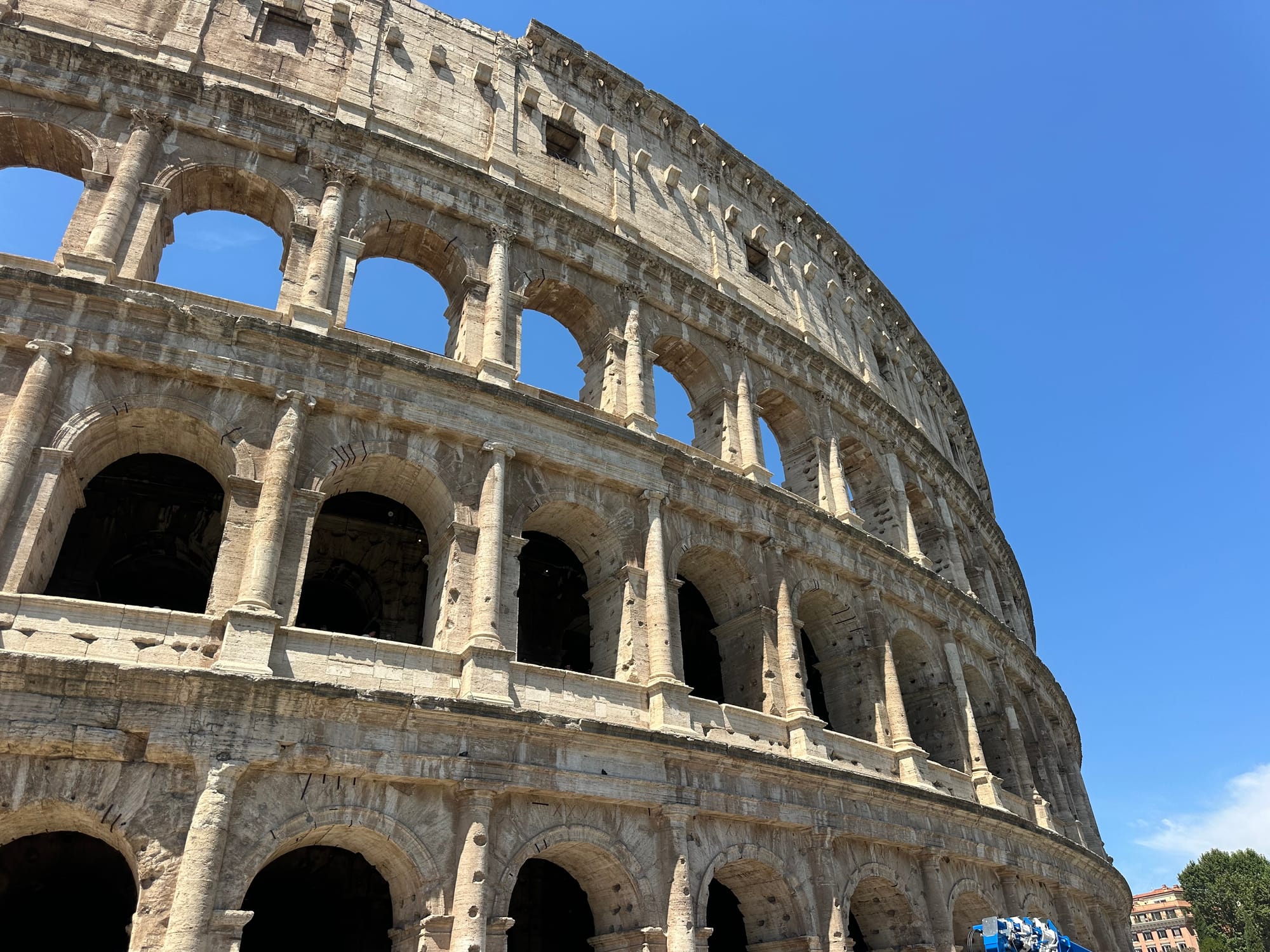
Rather than being like, “Wow, Rome is amazing, and the buildings—the Colosseum was so cool—and the food was so good.”
We have become good.
We updated our own software in our bodies, and now we’re leaving with that.
How long does it last? I don’t know. Maybe forever. But we have that thing updated in our bodies.
That’s exactly what Lydia is talking about.
Super cool.
Charge Up, Journalists: The Technology Beneath Rome
On their final night in Rome, Max and LuLu reconnect through fruit and an ancient pine tree. What emerges is a reversal of conventional history: the monuments are not necessarily the technology—they may be layers covering the living organ beneath them. Every material, food, tree, and geographical point alters the soup of consciousness.
Chapter One: Reporting Live From Rome
Max: All right, I’m alive!
LuLu: And it is LuLu and Maxfield, reporting live for duty. Recording live from Rome.
Here we are. We’ve had a wild few days.
What have we been up to, Max Effect?
Max: We’ve been shifting the energy of the Vatican and reconnecting it—and the Basilica and the Pope—back to Earth energy and Mata consciousness.
But right now, we’re reconnecting into the grid of nature through the trees.
This is a really great trick you can do when you’re in a city that is blocked off from the technology of nature and the resonance of Earth.
You can go find some really, really fucking old trees, take off your shoes, and sit your spine down into the base of the tree.
LuLu: Or the roots.
Max: Yeah, the roots.
You want to find an old one that’s really rooted.
LuLu is sitting at the base of it, and I’m just kind of pacing over the root system.
It’s a pine tree, so its roots generally go a little more shallow and far out. They’re on the surface, and that’s where I am.
Chapter Two: No Water, No Electrical
Max: The Vatican doesn’t have very many trees. They’ve all been choppied.
I don’t think it’s malicious, but it has cut them off from the grid—especially when you put granite and marble on top.
No water penetration means no electrical.
It also means no electrical. No water, no electrical, no light.
No sound really goes through it.
It’s impervious.
LuLu: We were talking about the importance of eating fruit, especially in places like this.
Get some light and prana into your body.
Max: Yeah, we’re able to even record right now because we just zoomed up and got a bunch of fruit into our system.
Lydia is plugged into a tree. That’s why we’re even able to get to this, realistically.
Chapter Three: Every Ingredient Is Consciousness
LuLu: Everything matters.
This is the conversation we were having earlier about the type of material the walls are made out of, the floor, the fabric of the sofa—everything.
Everything is an ingredient in your experience of life and in the database of information you have access to.
It’s like the soup you’re in. There are ingredients in the soup.
If you put pine needles in a soup, it changes the whole soup.
If you put cement in your soup, you’re going to have a very funny flavor of soup—and it’s going to be very toxic.
I’m just having this re-realization that every single thing matters.
Every single ingredient is part of it.
People go to the grocery store and say, “Oh, this isn’t a big deal. There’s just a tiny amount of it,” or something.
Every ingredient impacts consciousness in some way, good or bad. It all impacts it.
Chapter Four: Plums and Nannapusses
Max: Especially the fruit.
We found plums. How many plums have you had in the last two hours, Lydia?
LuLu: Five plums.
Max: Five plums.
I’ve had one plum and, I think, three or four nannapusses.
LuLu: That’s a banana.
Max: And yeah, we feel more alive. We’re on the roots of these trees. It has helped dramatically.
It’s like, la-da-da.
Chapter Five: The Final Night
LuLu: So, we just did Rome.
We’re at the final night.
The final night.
I’m looking at big buildings that I’m told were very important in history books. And they look like they’re very important.
At the same time, I think it’s just one part of the story.
What about the trees? The water? The birds and the bees?
What about the chemistry?
Max: Lydia did her first rap song today.
It was about pocket cucumbers. It was about pocket cucumbers and sneaky tricks.
LuLu: That pocket cucumber is a sneaky trick?
Max: Yeah.
Chapter Six: The Structure Is Not the Technology
LuLu: I guess the thing here is really redefining.
The thing that’s been coming through is redefining what I previously understood to be the technology of the pyramids, certain temples, and whatnot.
The message conveyed to me here is that these buildings erected at particular geographical points on Earth—those structures are not themselves the technology.
Sometimes they’re actually an anti-technology.
They’re capping the real technology, which is the vibration emanating out of the Earth—on the body of Earth, you know?
Max: Yeah. The Earth’s amplitude—the Earth’s potential there—has actually been capped in an attempt to harness it.
Chapter Seven: Four Inches of Laminate
Max: It’s almost like beautiful hardwood floors.
In people’s attempts to love them, they love them and love them. Eventually they go, “Oh, well, let’s paint them a special color.”
Then, “Oh, we’ll laminate them this color.”
The raw wood gets covered in colors and colors and colors.
Then someone goes, “Oh, well, I don’t like that.”
They go, “Well, let’s make it pretty. We like the hardwood floor. Let’s laminate it.”
Someone else goes, “Well, let’s laminate that. I didn’t like the polka-dot laminate. I want black-and-white squares.”
Two hundred years later, it’s four inches thick, or whatever, with this laminate—and the hardwood floor is missing.
It’s not even there.
It’s covered in chemicals and covered up. It has lost its flavor and influence.
That’s the same thing that’s sort of happening here.
Chapter Eight: The Organ Beneath the Pyramid
LuLu: That is the intelligent thing. It’s the most intelligent thing.
Those fucking pyramids at Giza are not the technology.
It’s the geographical point those pyramids were built on top of. That place is the technology.
On the body of Earth, it’s like an organ system—in the same way our bodies have an eye, a nipple, or an ear.
All these places on the planet are some particular organ system, sensory organ, or technology that’s part of the body of Earth.
Different people have roamed the Earth and felt these places—and their significance—really potently in their bodies.
I think things have become misconstrued and misunderstood. People then try to harness that technology through structures, rather than allowing the energy of that part of Earth to flow through their bodies and upgrade their bodies.
Chapter Nine: Zombieland and Real Food
Max: Now we’re in Zombieland.
The food plays a big part.
We just ran into a couple from Greece—from Athens—and they seemed to be doing just fine. They knew this was codswallop going on here.
Nonsense.
They must have found some access point, even if it’s just good, real food. Fresh fish from the sea and things like that.
That’s enough.
I don’t know what their diet is like, or where, or what—but the fact is, they knew.
We met them in the grocery store. I was telling them, “This is all shit, and it’s all dead.”
They go, “Yeah, it is all shit, and it’s all dead.”
They go, “What do you do? Everything is so expensive. We can’t eat anything. We’re so hungry.”
He looked at me and was like, “And you’ve got to eat a lot. You’ve got to eat a lot.”
I was like, “I know.”
I guess I tried to teach him, but maybe I should have used it as a reminder myself and just eaten a lot—which I did.
I bought a bunch of snacks for tomorrow. I’m loaded up and ready to go, thanks to LuLu Bear.
We’re approaching our cutoff time for this recording.
Is there any capstone you would like to add, LuLu Bear?
LuLu: I had something, but I forgot it now.
Charge up, journalists!
Ten Ingredients and a Teammate: Recovering Genius in the City
Simple chicken and rice restore Max’s charge after days of city depletion. LuLu traces how cities and ordinary food dim intuition, resilience, and the “geniuses” within the body. Their solution is uncompromising: trees, bare feet, fruit, minimal ingredients—and a teammate willing to exchange ordinary social life for the deeper potential of the being.
Chapter One: Charged by Chicken and Rice
Max: And we are live.
We just had a little bit of fun chicken at the grocery store, thanks to Lydia.
Normally, I can never eat it. But it looked like it was just chicken, water, salt—basically. Maybe some thyme.
We’re walking back to our hotel.
I’m able to eat it, which has charged me up pretty significantly, in one sense. Normally, I can’t do this, so I’m quite stoked.
That might help us solve a little bit of Italy for the next few days. Maybe they have a local grocery store where they’re doing something like this.
Then I had a little bit of rice—some sort of rice mix—which is exactly what I asked for.
I was like, “I just need a bowl of rice.”
Lydia found it. Well done, Lydia.
Simple foods, man. Simple foods.
The level of charge in my body compared to 30 minutes ago is significantly different. I’ve got a lot of energy now.
Chapter Two: When the Genius System Dims
LuLu: Yeah, it’s something I’ve been feeling and noticing a lot over the last few years.
My body does not want to be in the city anymore. It starts to really scream at me after four or five days of being in a city.
Eating normal foods, or whatever, on top of that makes my whole intelligence system dim really, really quickly.
My abilities and intuitive capacity start to wane very quickly.
Resilience. Prana. Vitality.
Desire to live.
The geniuses we have inside us become disabled because we’re cut off from the thing that birthed those geniuses.
Chapter Three: Get Your Ass in a Tree
LuLu: So it’s like: fuck.
If you’re in a city—or have to be in a city—get your fucking bare feet and your ass in a fucking tree as much as possible.
Eat fucking fruit.
Get it in a bowl of fruit.
Get your feet in a bowl of fruit, dammit.
And try to eat, like, fucking ten ingredients.
If that’s your life and that’s the option you have, there are little tricks. There are ways to reconnect yourself as best as possible—to access your genius again and access your body technology again.
But you’re not going to be able to live the same way everybody else does.
If you do the same things everybody else does, you’re going to have the powers and abilities everybody else has—which right now are not particularly developed or evolved in most humans.
Chapter Four: You Have to Trade Out
Max: If you feel like you’re going to lose your social life by making these changes, that’s part of the deal, brother, sister, middle.
You’ve got to trade out.
You’ve got to trade out.
LuLu: You really have to choose what it is you want in life.
Do you want a social life? Do you want to sit with friends in restaurants and eat and drink the normal things people are consuming?
Or do you want—
Max: This is our hotel to the left. We should just go back, and we’ll refill the water tomorrow, yeah?
LuLu: Sure, yeah.
LuLu: Or do you want to crack the highest potential of your being and know what you’re capable of?
And those are—
Max: Can you reach into my left—or my right—pocket?
LuLu: And those are different lives.
Chapter Five: Finding the Opposite Teammate
LuLu: Hopefully, if you’re lucky, you find a teammate to do it with you. That’s really fun.
I think it’s almost essential.
Max: It’s very hard to do alone, out in the world. Super tough.
It’s just soul-crushing.
I think that’s the issue, to be honest—because it costs so much.
You almost need someone to play the opposite thing.
They enter the hotel. The recording falls quiet for a while.
Chapter Six: The Air-Conditioning Divide
LuLu: I hate AC. I fucking hate it.
Max: It’s just too hot for me.
I know you hate it, but I just can’t function.
LuLu: I’m a jungle Asian.
Give me that no-AC life any day.
Max: Can you take this off and put this in the trays?
LuLu: Of course, my love.
Max: Thank you, my love.
My sweet chicken-apple-honey-bun.
Chapter Seven: Duplicating the Experience
Max: Well, the living thing has been prompting ways to do something.
You know, it’s working.
We’ve found a way now to rapidly duplicate ourselves and multiply our own experience out into the world—which benefits us primarily, numero uno, and then numero dos, benefits others.
Thank you for being part of this experience with us.
All right, LuLu. Let’s connect with you and me right now. We’ve got about four minutes.
Let’s just let this thing see how we are.
Let it be.
Leave your mic on, I guess, and it should capture us in the room.
LuLu: We’ve got a feet touch.
Feet touch.
Feet touch, hand touch, breathe.
Same.
Max: You look like an emperor penguin.
Chapter Eight: Packed Enough
Max: Are you ready to go, Lydia?
LuLu: We’re packed enough.
Max: Packed enough.
I mean, this is a ten-minute cleanup.
LuLu: Yeah.
Max: Okay, if you’re going to shower, I’m going to shower.
Another long silence.
Say hi to the—
I almost want to eat a fucking banana.