Bodywork on Planet Earth

Bodywork on Planet Earth
A conversation about Earth as a living body: cities as fascial adhesions, volcanoes and gravity fields as organs and nerves, human bodies as temporary bridges, and the internet as a synthetic mycelium attempting to restore a fragmented planetary intelligence.
Chapter I — After the Vatican
Max: So, we just got one of our articles confirmed, let’s say, about some of the work that we did in Italy. And I’m caught up in this idea of being dreamy—which is part of my job—about these things and what it could mean.
And this idea that, if we can work on the Vatican—which is what happened—basically, Vatican News published that they are deciding that nature is of critical importance, and that we must include the screams and the cries of Earth as we move forward. That we must tend to these things, which is exactly what Lydia and I’s work was on—what our work was on.
And so I’m now sitting here questioning, like: what is the next kind of thing?
Do we go to Ratnapura, where these gems—which are deep-Earth minerals—have reached the surface, and these beings are there that are known to have profound capacity? Do we go talk with them? Is that part of the deal?
I got a guy who just said he’d rent us the motorbike. It’s a great three- to five-hour ride, whatever. It’s pretty long, but it would definitely test us on the motorbike and give us that chance.
What do we do? Do we go to Borobudur again? How do we fund it? Getting Ghost really live to be able to fund this, so we don’t have so much money and stress as we travel—and the pressure.
Chapter II — Fascial Adhesions in the Body of Earth
LuLu: Something that was coming to me that was relevant to the bodywork we’ve been doing—and thinking about it in this greater context of Earth—is that Earth moves through the solar system. Earth moves through these really massive cycles, like 2,500-year cycles.
And as these cycles come to an end, of course, it shifts into this new paradigm. And apparently, as I’ve felt into it and how it’s been communicated to me, that shift into this next paradigm has been faltered in some way because of the adhesions that are in the body of Earth.
They act much like fascial adhesions in the body, where they constrict the passageways—the informational passageways of nerves—that allow the whole body system to efficiently communicate with itself and to be aware.
And so there are these adhesions in Earth because of these massive cities of concrete that inhibit that informational flow.
Something about us going from place to place—through our bodies, kind of uploading these places that have been cut off—and going to places that are deeply interconnected and interwoven with Earth, absorbing through our bodies the information that is there, bringing it to other places, and spreading it through Ghost and other ways too, seems to be part of it.
And so the parallel that I made—the joke that I made—was: it’s like we’re doing bodywork on Earth.
Probably something that’s going to be happening over the next 50 years or so is a lot of strange weather events. Really strange weather events that are participating in this opening-up of these fascial adhesions on Earth.
And I think going to these places and channeling these beings—the reason why that’s important—is because that’s part of the information that’s been lost to us because of how the body of Earth has been locked up, you could say.
Chapter III — The Veins, Arteries, and Nerves of Earth
Max: Right away, I think of the capital of Brazil, which was built in the middle of the Amazon fucking jungle—probably right at one of these energy centers—and they massively capped…
It’s raining so hard suddenly.
They massively capped probably a big energy outflow of the Amazon rainforest.
Again, I think of reconnecting back in. I think Mount Pinatubo, Indonesia, and Krakatoa—these are like the veins and arteries of Earth, these deep, oozing chemical things. Whereas where the gravity is different, those are like the nerves.
Sri Lanka is one of those places where the gravity is different. Easter Island would be a vein again, or an artery. Like Hawaii. Italy—I think Rome technically was actually one of those. Yellowstone is.
And plugging these things back into the grid—hearing their stories and letting their stories play.
Really, what bodywork—a lot of it—is: I am electrical. There’s an electrical blockage in their body. I put my hand down where the charge is flowing, and then I put my other hand on the other side of the blockage. The energy flows through me, and that connects the person back to that stuck energy.
So we are doing that. By us going and plugging ourselves into these places, we are sort of bypassing the blockage.
With Lydia, for example, I would put one hand on her spine and one hand on her lower leg, and then it skips over that blockage in her pelvis. These things flow fluidly, and they come through my body generally first because I am in the middle of it. It flows through to mine, but then she gets these things.
And we’re kind of doing that for Earth, I guess. We’re healing Earth—reconnecting it and the mycelial connection.
And probably, once you connect it—like when we tell the trees, “Hey, these things are deep in there,” and we tell the current trees that can’t reach that depth in Rome, “Hey, listen, this is the data,” and then they tell everyone, “Hey, you guys, dig deeper,”—they send their roots down deeper and search for this ancient water that may be stored there, ancient minerals that contain these codexes deeper, and try to rebuild that mycelial connection.
That natural connection.
Chapter IV — The Synthetic Mycelium
LuLu: And one mycelial connection that is very active right now is this synthetic, digital mycelium that we have, which we call the internet.
The way these adhesions work, it’s almost like forming a bridge. It’s like when there’s an avenue where there’s been some kind of major accident, or a bridge has collapsed. What do you do? You open up a channel somewhere else so that traffic can still flow through, and then you repair that bridge.
And so, in a way, maybe that’s why we’re using the digital world right now to be able to do this.
These adhesions are very real and very devastating to the flow and consciousness of Earth. Not just Earth as this planetary body, but to the entire collective that receives the life that Earth generates for us.
Our database is fragmented. The human collective, the plants, and the animals—all of our data is fragmented and locked up in some way. None of us has the whole picture.
And so what are we doing? We’re kind of manually—this is the same way that bodywork goes—you manually go and make some kind of adjustment to restore that informational flow.
We’re using some strange combination of our physical bodies to do that, and then amplifying the information that we’ve absorbed through our bodies, using this artificial bridge of the internet to broadcast that information to the collective.
And I think, through that, humans start making different decisions. They’re carrying this information and truth within their body. So wherever they go, that information and that data start to update those places as well—somebody in New York, somebody in Beijing.
And so this web through human bodies starts to be uploaded. The information of these places starts to be uploaded through them by having heard them, having listened to them, and processing that information.
And that mycelium can restore.
I think over time that’s going to really change how we do civilization and how we build cities. Maybe we’re going to rebuild a lot of cities in a different way so that those adhesions are no longer there—because we start to realize what the body of Earth is:
This life-generating technology. This feminine consciousness principle. This zero principle. This thing that births everything.
Chapter V — The Internet as a Temporary Bandage
Max: Reframing the internet as a bandage—a temporary bandage so that a wound can heal—is more insightful for me, and more welcoming of this whole digital concept, because it is what’s happening.
The exchange of data that’s going on globally, to bring awareness to the poor and the suffering and the state of things, is so vast. Deep knowledges that were left—and ancient knowledges—are being translated and decoded using AI, and then dispersed. And it is quite fast.
I can research ancient Chinese. I can find out what ancient Chinese immortals were saying 800 years ago in 15 seconds on my phone.
I think that is a massive bridge gap. With a different language written in some temple, I’d have to trek across to that place because there are, whatever, 100 books in the entire Western regions. And now it’s just slammed there. I’m able to contribute and connect with that.
Chapter VI — Before the Natural Network Was Severed
LuLu: Yes. What’s come to me is that, at some point, before there were a bunch of fascial adhesions through the body of Earth—when there were big fucking old trees and all of these main arteries and highways of Earth, natural highways of information that were unobstructed—people, life, plant life, animal life, all of it, were constantly going through informational upgrades because none of these nerves and pathways of Earth were obstructed.
So people were getting downloads of information constantly. Something was happening in one region of the world—some upgrading consciousness from someone in a cave or whatever—and immediately it would spread to the collective.
And at some point that shifted through these buildings. It happened a long time ago—more than a couple thousand years ago—that these massive mycelium networks started being destroyed. And then pavement and sidewalks and buildings and all of these things started to come in too.
Somehow, maybe unintentionally—this is kind of how the subconscious or the unconscious and the collective work—unconsciously, we have erected this false network system.
It is still just a bandage. It’s not the real thing, and it’s sort of tainted and distorted, because whenever you have this false bridge, you can put anything through it. The amount of lies floating around the internet is quite high.
But you can also use this bridge for the updating of truth back—and plugging it back into the collective.
And I think it’s temporary. If people return to this state of being able to intentionally pass information to one another, then really, what use of the internet would there be?
That capacity and that technology would exist inside of us as a collective.
Chapter VII — A Bridge Is Not the Real Thing
Max: I’m just inspired by this idea of the internet being like a temporary bandage—a high-rate bandage for people who have lost their ability of intuition and such. It does reconnect them into new ideas, new possibilities, and other methods.
Roads do that, I guess, technically. Giant bridges and airplanes. It is a temporary ability to overcome. So that’s kind of a cool perspective on it.
And satellites and all that stuff that’s coming—satellite radio and satellite data. The internet is now becoming satellite, but right now it’s hardwired.
It’s like a pulsing Earth, this dynamo of Earth that’s in harmony with itself. Imagining that.
I think coming to understand what is a temporary bandage versus something that is real—we have to look at whether or not it erodes and destroys the human body and the body of Earth, or whether it makes it more well.
And I think that’s how we come to whether or not something is a true cure and a true solution, or if it’s just—
LuLu: Is that a parakeet or a parrot? What is that?
Max: It’s a parrot.
LuLu: No, what is that? I don’t see them here very often. It’s so beautiful. I haven’t seen them here before.
Anyways, as a result of this conversation, I realize so many people will say, “If the internet is that bridge, if airplanes are that transit system, then what’s the issue?”
The issue is that it’s destroying our bodies slowly. It’s atrophying capacities within us. And whenever certain potentials and capacities aren’t used inside of us, that part of us dies.
It’s the same thing: since automobiles, since cars came to be a thing, we’ve seen—slowly, slowly over time—further levels of unwellness made manifest in the body.
Maybe animals haven’t seen that to the same degree because they’re not living in this world where the potentials and capacities inside of their bodies are being outsourced to other places. They’re still walking and running. They’re still using their instinct to locate where water is and which way north is.
In a strange way, it’s this constant question: have humans evolved, or have we devolved?
If you suddenly unplugged the digital realm from humans, and we didn’t have access to cars and computers, are we a more intelligent species?
The answer is no, actually. We’re dependent on these things outside of us. As a species, as a body, as a technology inside of ourselves, we have not become more able.
We have become more disabled.
And so I think that’s what’s happening right now—and that’s why these things are important.
Outsourced Abilities and the De-Evolution of the Body
A conversation about civilization’s external tools replacing the body’s native intelligence—from navigation, movement, and instinct to the chakras and the mind—and why knowledge of human potential means little unless it is lived through the body.
Chapter I — What Remains Without the Tools
LuLu: Just as an addition, maybe some examples of what I mean by this are: you take away people’s cell phones, and their houses with their electricity, and their cars, and their calculators, and their compasses—which obviously exist on our phones—and you very quickly realize that humans have lost a capacity to navigate themselves directionally, to be able to find water, to be able to sniff out where the water and the food is.
And that’s reduced our ability to sniff out what is true and untrue.
You see this happening also with animals that live in cities. They stop being able to smell the chemicals in food like a wild animal. It kind of depends, but there are a lot of things that we eat in society that animals—wild animals—might smell and be like, “Fuck no, I’m not going to eat that.”
And you see that, over time, domesticated dogs and ducks that are in parks and cities, they lose this ability to smell something that is poison to their body.
If you take away all of our digital toys, and our cars and our automobiles, humans aren’t necessarily able—as a collective—to run faster. We aren’t able to lift heavier things, most of us. We aren’t able to have functional movement. We aren’t able to climb the side of a mountain. We aren’t able to jump from one tree branch to another. We aren’t able to, like, feel—feel pain. We aren’t able to empathize as deeply.
We aren’t able to sense what’s happening in the world around us. Our technology has dimmed in this way.
So it’s just this idea—this kind of strange flip in perspective—where people talk a lot about how much we’ve evolved as a species. But we haven’t evolved as a species, actually. We’ve just outsourced certain abilities.
Civilization has advanced, you could say. But if, 100 years from now—or even now—you take the body of someone who lived 3,000 years ago and the body of the average 20-year-old college student, that 20-year-old college student is not more well.
If you just look at their body—the state of their body—like an archaeologist, some future archaeologist is not going to compare these two bodies, of a college student in New York City in 2026 and the body of an ancient human 3,000 to 4,000 years ago, and say that this New York college student is a more advanced being.
They just have more toys.
Chapter II — What the Bones Would Reveal
Max: Yeah. I mean, imagine if you dug up the college student right now. There’s so much sickness. You would see deterioration of the bones and malformations, and the stressors on them would be someone who’s sedentary and sick.
If someone 400,000 years from now dug us both up—someone from 3,000 years ago and someone now—they’re the same timeframe. They’d be essentially at the same layer in the soil.
You would just assume that the person today was sick, on bed rest, because their bones would be sedentary. They’d be a person who didn’t move much and who had a lot of disease.
Interestingly, in the sands of New Mexico in the United States, in White Sands, they traced footprints. There are loads of footprints that got saved in time. And these footprints are rewriting human history because they date back very far—22,000 years ago, at least.
In fact, there’s a human footprint track that is in a footrace with a dinosaur. The human footprint is below the dinosaur’s—like they stepped in the mud first, and then the dinosaur stepped after.
And this human—which is interesting—they can track the pace of their sprint by the foot distances. I think they were running 23 miles an hour.
That’s Usain Bolt, essentially—the fastest man today. This is your average person running from a dinosaur, in all fairness, which is probably pretty activating.
Chapter III — What Bodily Deterioration Actually Means
LuLu: I just want to add: what does this mean? What is the issue of the physical body deteriorating?
Again, people might think, “Well, the reality is that we do have all these toys, so what’s the problem?”
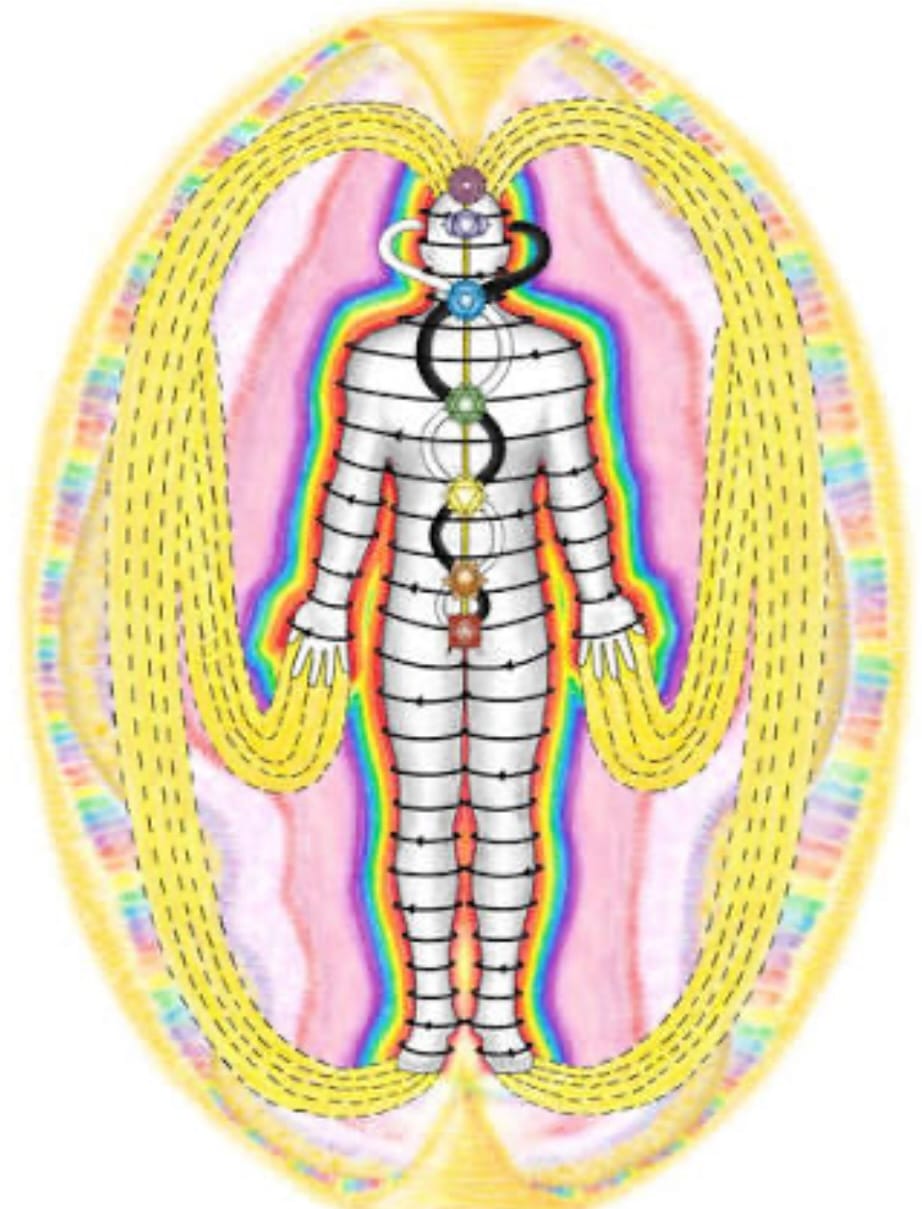
And I think a great example of this right now is: previously in human history, what we see in our bodies right now is that our root chakra has deteriorated. That’s going to be our legs, the sexual organs. It’s going to be our power—in a way, our power of creation—and our ability to respond to life imminently. It’s going to be how we act and move in the world.
That’s going to deteriorate.
Our sacrals are going to deteriorate because we’re eating a ton of chemicals, which means that our ability to alchemize life and create beauty, and our capacity for intimacy, is going to deteriorate.
If the solar plexus deteriorates, that means our ability to defend, and use our will to direct life in some way, is going to deteriorate.
That’s what happens when these organ systems in our bodies start to deteriorate.
What we’re seeing now, in this moment in time, is that through AI, people’s third-eye chakra—you know, sixth chakra—is going to deteriorate. That’s our mental capacity.
So far, up until this point, we’ve kind of—maybe in a strange way—you could say that we’ve been developing it, or we’re living more through that space.
But because now we’re using outside systems to process data and think for us, the technology that is inside our bodies that is meant to do that is going to very rapidly deteriorate.
The same way as if you sat in a chair for a long time, your legs will very quickly atrophy. Because we’re using—and again, it’s been happening for a while—our capacity to think and reason and make connections by synthesizing data is going to dramatically reduce.
And again, that’s not an evolution of our species. That is a de-evolution.
Chapter IV — Biological Evolution Versus Technological Evolution
Max: Yeah, I mean, scientifically, you would just say: biologically, we are devolving in potential. Through technology—which is a different science category—you could say we’re evolving mathematically. You could say we’re evolving, potentially. I don’t even think we are, but mathematically you could say that we are.
But biologically, we could say that we’re seeing a lot. And people are like, “Well, no. You see that cells are evolving, and mitochondria—we picked them up, and now we’re living in this way.”
It’s like, yeah, in the grand scheme, for 99 percent of humanity there’s been evolution. But it’s this last little bit, potentially, that there’s a de-evolution.
And anyone who’s studied science sufficiently knows that these are common waves. It’s ups and downs, and highs and lows. We’re on a roller coaster. And the screams of now—you’re going to have screams at the next hill too, on the way down.
It doesn’t make them less important or impactful. But the point is that these things have come and gone.
Sixty-seven thousand years ago, there was a mass die-off on the planet. Everything was wiped—way more than today. They estimate there were 5,000 humans alive. Like, a complete wipeout.
And you think about what they would have been through, and how their technologies would have shifted, their bodies would have been shifting at that time, and blah, blah, blah. And then the resurgence after, and what that would have been like—the euphoria of humans rapidly evolving.
And the ones that chose to eat fruit—literally seeing the difference between the ones that went into the plains and ate fruit, versus the meat eaters on the beach eating oysters, and seeing how different those lives are.
They probably almost became different fucking species again.
That’s how species separation happens: when people eat different things in different environments and use their body technology in different ways, you could say.
And again—42,000 years ago.
There’s a lot happening. There’s a lot shifting in this. A lot shifting in this.
Chapter V — You Are Not Living the Data
Max: And I think—I, having been a scientist for some time, I know the arguments, the counterarguments to this. I’ve heard them so many times. I was on that side in many ways.
And the thing is that if you are Stephen Hawking in an electric wheelchair, you’re not in the conversation of basketball.
Although he can comment, and know the physics, and the games, and the stats, and the points—he’s not in the conversation of basketball.
And I think that this is where the people who are going to be confuzzled, and they’re going to fight on this thing and go, “No, no, no, the data is not right.”
It’s like: you are not living the data. You have no idea. You have no idea.
And I just feel like that’s a critical point for people who are listening, going, “This is all bullshit.”
It’s like, are you actually spending any time out in the forest? No phone, no fucking fancy boots. Are you just out in the forest the way your ancestors were, testing your body to see what it can do—leaping across streams and crawling up rocky walls on all fours and things?
Because if you’re not doing that, then you’re not really in a position to comment on what was or wasn’t happening. It is impossible.
Because the game starts to change very quickly when you do that.