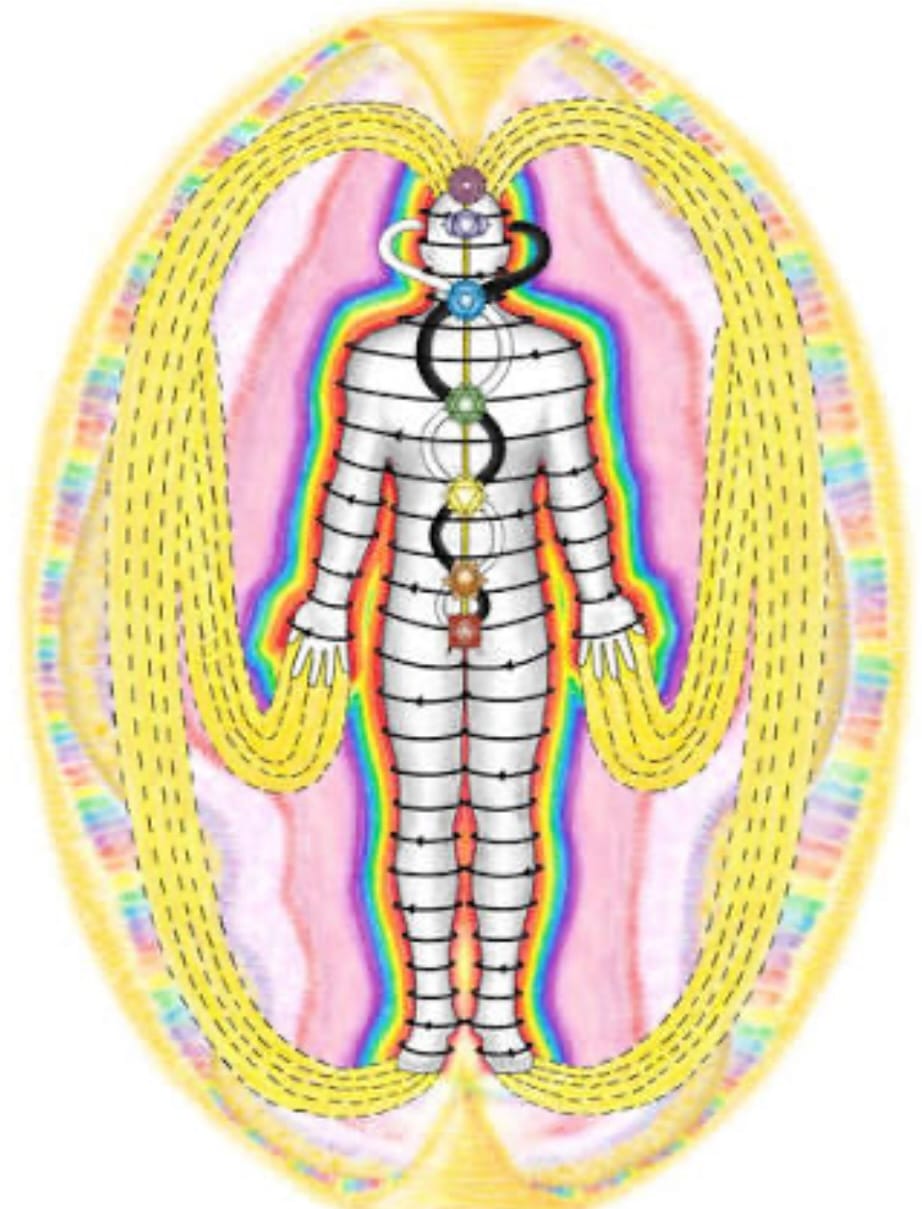
➕ and ➖ of activating ancient codes

The Birth of an Off-Road Genome
Max and LuLu prepare to meet a woman whose plant-medicine initiation appears to have activated something her former life cannot contain. They explore ancestral intelligence, the body’s refusal to fund a false blueprint, and the depression that emerges when a person receives a new vehicle but continues trying to drive the old road.
Chapter One: Returning to the Homeland
Max: And we’re live.
We’re just about to meet up with two individuals—who will remain anonymous—who requested our help. They traveled an incredible distance.
One flew from Brazil. The other drove some five hours or something like that, after I drove to them several weeks ago.
The Brazilian person is really having a tough time. She says she’s depressed, which feels rightly so. She looks like it. Her eyes are black. They’re dim. She’s very still.
What we’re going to do—and what I think the discussion is—is: what will we do?
For me, my understanding from working with these people is that she needs to connect to her homeland immediately. That was my intuition weeks ago.
She’s got to go get in the dirt, be around the people, and look into the eyes of the people she came from.
And remember.
Then the illusion falls away very clearly, very quickly.
Chapter Two: The Mata Gene
LuLu: What was communicated to me when I connected to her body—and I haven’t met her in person, but I’ve connected to her back and forth over the phone—was that she actually has, through her mother lineage, through her Indigenous Brazilian lineage, the Mata gene.
It’s just inactive.
I think what’s happened is that, after several generations of eating really edited food—really not-real food—and also being thrown into a system where she’s working the same hyper-capitalist routine that many people are, over several generations her mother lineage has unplugged itself from that Mata gene.
Right now, particularly, the food being eaten continues to sever her from this thing.
For me, at least, a big part of it is going to be inspiring her. It’s basically showing her that she’s living a synthetic version of her life—or a synthetic version of her body technology—because she’s inundating her body technology with synthetic codes.
Over several generations, those synthetic codes overpower or unplug you from the wisdom that’s in your bones.
That wisdom tells you how to live life day to day and what your mission is. It gives you the energetic and physical resources to pursue that thing.
Chapter Three: Activated at the Train Station
Max: You know, I think it’s—well, her job.
Her job has taken her away. She’s the CEO of a large company that does organization.
This is a woman from the jungle. She doesn’t give a fuck about organizing the lives of wealthy city people. Her DNA doesn’t.
Not that it can’t do it. It just doesn’t care so much.
Prior to two years ago, she was fine with that. Then I believe she did ayahuasca, and then she was like, “Well, I can’t do this,” and has been in depression ever since.
She did it again about a month and a half ago. From there on, she’s been stuck—locked, frozen—in what most would call a trauma response.
Which I would just call: essentially, you’re deactivated.
You’ve been activated, but you’re sitting at the train station. You haven’t boarded the train.
Chapter Four: The Body Will Not Let You Go Back
LuLu: It’s like she was activated through that initiation she had with the plant medicine. That probably initiated the reconnection of that sequence to the Mata gene.
But she hasn’t followed it through with shifts in her life.
It won’t let her go back. That’s the interesting thing.
Once that thing is activated—or partially activated—in your system, it will not let you go back to the way you used to live.
You can, but it’ll be very hard. We do see this with people.
But when it’s that much of a shift—which probably happens when you do these plant medicines—it rapidly shifts her off her life. So she’s kind of stuck.
She knows she can’t go back. She doesn’t know how to go forward.
Many people who do psychedelics end up in this situation. There’s this stall-out here. Or they leave home and they’re like, “Well, where do I go?”
They get stuck in this stall-out.
I feel like that’s the body’s protective mechanism.
It sounds like it’s kind of counterintuitive and unproductive, but it’s actually the body protecting its resources.
Once this gene is activated on some level—even if it’s only a subconscious bodily remembrance of what it’s actually meant to be living and what it’s meant to be doing in this life—the body will not let you allocate its physical resources toward something that has nothing to do with its blueprint.
So it will shut down the body and depower, maybe, the crown chakra, for example.
It will stop allocating dopamine to allow you to check off these goals and lists that are totally disconnected from the blueprint of the being.
Chapter Five: A Different Person Inside the Same Life
Max: Your geometry has shifted.
If you’re following with us, you’ll hear this over time, but when the geometry shifts, you fundamentally shift. The architecture has shifted.
When you take a medicine like she did, she shifted her geometry—her architecture—her DNA activating and replicating and creating a different person inside of her.
That different person is now living in that same life, and it can’t do it.
It doesn’t. It can’t. It’s not the same person anymore.
Chapter Six: The New Vehicle
Max: When they try to operate, it would be like if you traded in your car.
You had a four-by-four off-road car, and you traded it in and got a luxury Ferrari. Keep it simple—you got a Ferrari.
You get in that car, and you can’t drive it off-road anymore. It just doesn’t do it.
You’re going to sit there, parked at the rocks on the off-road road, going, “I can’t do this.” Or you’ll literally crash and get stuck somewhere, and someone needs to bail you out—which is what we’re doing for her.
She needs a tow.
We’re going to try to tow her back and be like, “Hey, you have a different vehicle now. This isn’t the life you can live anymore.”
You chose that. You can continue to try down here, but you’re going to live in misery.
The idea is to get her onto a path where she can understand:
What kind of vehicle am I driving now?
We think she actually switched to an off-road vehicle. She was driving something like a city sedan. Now she’s got an off-road vehicle.
She’s got to go off-road with that thing, or it’s going to feel pointless. She’s going to be missing the use of her vehicle.
There’s a sadness when you lose your life and can’t do the things you used to do. But it’s like: just do something different.
You’re just attached. You’re like, “Oh, well, I used to be that thing. I used to be a sedan. I used to drive so fast through the city streets, and I used to be able to stop so good.”
Dude, when you take your new off-road vehicle and drive it off-road—and it rolls, and you get around trees and wild animals, and you get out in nature—you’re going to see that the aliveness of that is stunning.
Stunning.
Reminder: this was sponsored by chocolate chip cookies and protein powder.
</div>